
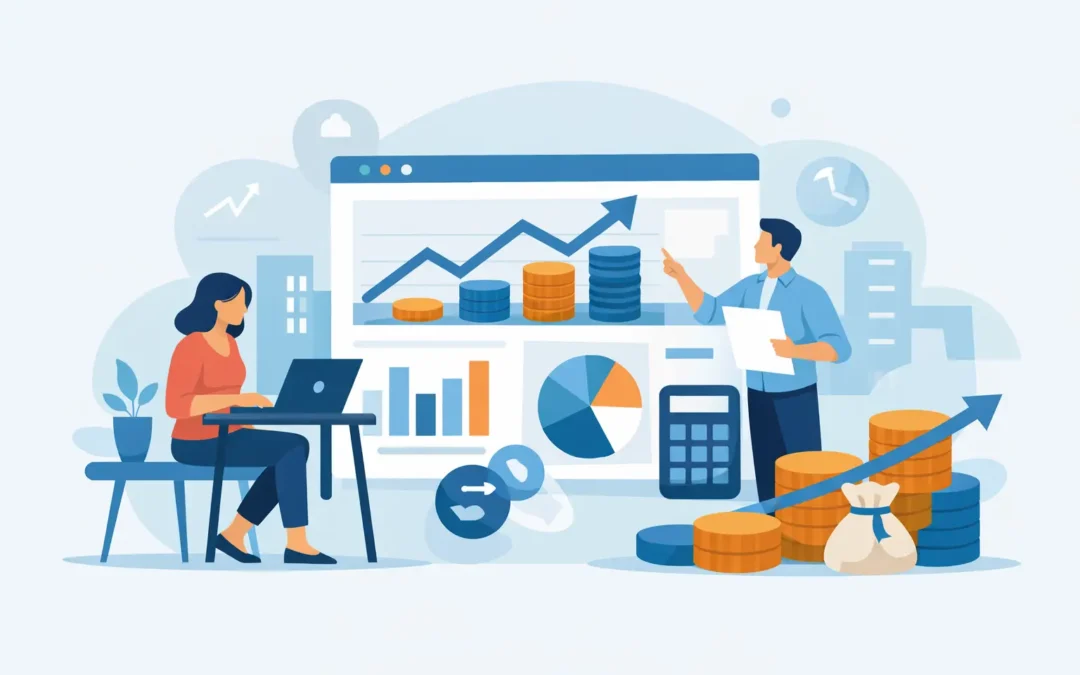
A profitable month on paper can still leave you short on cash by Friday. That is the reality many owners face when receivables lag, payroll hits, inventory needs replenishing, or a tax payment lands at the wrong time. Cash flow forecasting for small business gives you a clearer view of what is coming in, what is going out, and where pressure points may appear before they become urgent.
For many small and mid-sized businesses, cash flow problems do not come from a lack of effort or even a lack of sales. They come from timing. You may have strong revenue, loyal customers, and a full pipeline, but if cash does not arrive when expenses are due, the business can feel strained very quickly. A good forecast helps turn that uncertainty into a manageable planning process.
What cash flow forecasting for small business really means
At its core, a cash flow forecast is a practical estimate of future cash movement over a set period. It looks at expected cash receipts, such as customer payments or loan proceeds, and expected cash disbursements, including rent, wages, vendor payments, taxes, debt service, and owner draws. The goal is not to predict the future with perfect accuracy. The goal is to improve visibility so you can make better decisions in advance.
That distinction matters. Some business owners avoid forecasting because they assume it requires complex financial models or precise long-range predictions. In practice, a useful forecast can begin with straightforward information from your books, your sales pipeline, your billing cycle, and your known obligations. Even a simple 13-week cash forecast can reveal issues that your profit and loss statement may not show clearly.
This is also where cash flow and profit often get confused. Profit measures whether your revenue exceeds your expenses over time. Cash flow measures whether money is actually available when you need it. A business can be profitable and still struggle to cover near-term obligations. It can also generate positive cash in one period because of delayed payments or financing, even if profits are under pressure. Both matter, but they answer different questions.
Why forecasting matters more than many owners realize
When business owners have limited financial visibility, they often make decisions reactively. They delay vendor payments, hold off on hiring, pull back on inventory, or draw from a line of credit without a clear repayment plan. Those choices may solve a short-term problem, but they can create longer-term strain.
A forecast changes that dynamic. It allows you to anticipate a seasonal dip, prepare for slower customer payments, or time large purchases more carefully. It also gives you a stronger foundation for strategic decisions. If you are considering expanding, taking on debt, increasing payroll, or opening a new location, your cash position matters just as much as projected revenue.
For smaller businesses especially, this can provide peace of mind. Owners are often carrying responsibility for employees, customers, and family finances at the same time. Having a realistic forecast reduces guesswork and supports steadier decision-making.
What to include in a useful cash flow forecast
A good forecast starts with your beginning cash balance and then builds forward by period, usually weekly or monthly depending on the business. Weekly forecasting tends to work better when cash is tight, revenue fluctuates, or payroll and vendor timing need close attention. Monthly forecasting can be enough for more stable operations.
On the inflow side, include expected customer payments based on actual collection patterns rather than just invoice dates. If clients typically pay in 30 to 45 days, your forecast should reflect that reality. You should also include any other likely cash sources, such as tax refunds, financing, owner contributions, or asset sales, but only when they are genuinely expected.
On the outflow side, include both fixed and variable obligations. Rent, insurance, payroll, debt payments, subscriptions, and recurring vendor invoices are easier to estimate. Variable costs such as inventory purchases, commissions, contractor payments, and taxes require more judgment. This is where a business owner’s operating knowledge becomes just as valuable as the accounting records.
The best forecasts are grounded in actual data, but they also reflect how the business really runs. A clean spreadsheet is helpful. A realistic one is better.
Short-term and long-term forecasting serve different purposes
Short-term forecasting, often 13 weeks, helps manage immediate liquidity. It is ideal for spotting upcoming shortfalls, planning payment timing, and deciding whether extra financing may be needed. This is often the most useful format for businesses dealing with uneven collections or rapid growth.
Longer-term forecasting, such as six to 12 months, supports budgeting and strategic planning. It can help you test whether growth plans are financially sustainable or whether margins are strong enough to support new commitments. The trade-off is that longer forecasts are less precise, so they should be updated regularly rather than treated as fixed.
Common mistakes that weaken a forecast
One common issue is relying on optimistic revenue assumptions. If your forecast assumes every proposal closes quickly and every customer pays on time, it will look better than reality. That may feel encouraging in the moment, but it reduces the forecast’s value.
Another mistake is ignoring irregular expenses. Sales tax payments, income tax estimates, annual insurance renewals, equipment repairs, and owner distributions can all disrupt cash if they are not built into the forecast. These are not surprises if you know they are coming.
Some businesses also fail to revise the forecast often enough. A forecast should be a living tool, not a document you create once and set aside. As collections change, expenses rise, or projects are delayed, the forecast should adjust with them.
There is also a tendency to separate bookkeeping from forecasting. In reality, the quality of your forecast depends heavily on the quality of your books. If receivables are outdated, expenses are misclassified, or liabilities are missing, the forecast may point you in the wrong direction.
How forecasting improves decision-making
Forecasting is not only about avoiding a crisis. It also helps you evaluate opportunities with more confidence. If you know your expected cash position over the next few months, you can decide whether now is the right time to hire, replace equipment, add a service line, or negotiate better purchasing terms.
It can also improve communication with lenders and advisors. A business owner who understands cash timing and can show a reasoned forecast is in a stronger position when discussing financing or planning for growth. That kind of preparation signals control and credibility.
For companies with seasonal patterns, forecasting becomes even more valuable. Many North Georgia businesses experience swings tied to construction cycles, tourism, retail seasons, or client payment habits. A forecast helps you prepare during stronger months for periods when cash naturally tightens.
When to get outside support
Some owners can manage a basic forecast internally, especially if operations are straightforward. But if your business has multiple revenue streams, inventory complexity, debt obligations, or uneven cash cycles, outside support can make a meaningful difference.
An experienced accounting or advisory partner can help separate assumptions from evidence, identify gaps in your reporting, and build a forecasting process you can actually use. That support is especially helpful when the business is growing and the financial decisions are getting more expensive.
At Profit Partners LLC, this type of work often sits at the intersection of bookkeeping, reporting, and CFO-level guidance. The numbers matter, but so does the interpretation behind them. A forecast should not just tell you what might happen. It should help you decide what to do next.
Turning the forecast into a business habit
The most effective forecasting process is one you review consistently. That might mean updating a 13-week cash forecast every Friday, comparing projected cash to actual cash, and adjusting the next few weeks based on what changed. Over time, this builds discipline and improves accuracy.
You do not need a perfect system to benefit from forecasting. You need a clear one. Start with the cash you have, the payments you expect, the obligations you know, and the business realities you understand better than anyone else. Then review it often enough to keep it useful.
Financial clarity rarely comes from looking backward alone. It comes from knowing where your business stands now and what is likely around the corner. Cash flow forecasting for small business gives owners that perspective, and with it, the ability to lead with more confidence, less stress, and better timing.
Forecasting when your revenue is rent and closings
A forecast built on a percentage growth assumption works for a business with recurring monthly revenue. It breaks immediately on property, where the two questions that matter are when a closing actually funds and whether a draw gets approved on schedule. Both are binary and both move six figures.
The version that works is a rolling 13-week cash view tied to draw schedules, closing dates and debt service rather than to a monthly average — that is what we build under fractional CFO services. And if the revenue itself is mixed, the first job is separating it: a community P&L is often three businesses reported as one line, and you cannot forecast a blend.
Recent Comments